
The Circular Economy is a restorative and regenerative industrial system that replaces the traditional "take-make-waste" linear model with a closed-loop framework. In this paradigm, products and materials are kept in high-value circulation for as long as possible through intentional design, maintenance, reuse, and recycling. By decoupling economic growth from the consumption of finite resources, the circular economy aims to eliminate waste and pollution while regenerating natural systems, providing a critical pathway toward global sustainability and net-zero emissions.
The foundation of circularity rests on three design-led principles: eliminating waste and pollution, circulating products and materials, and regenerating nature. In practice, this begins at the design phase, where products are engineered for durability, modularity, and easy disassembly. By ensuring that components can be repaired or upgraded rather than replaced, businesses can significantly extend a product’s lifecycle. When an item eventually reaches the end of its functional life, it is not discarded but is instead refurbished or recycled into high-quality secondary raw materials, ensuring that the "molecules" of the economy are never lost.
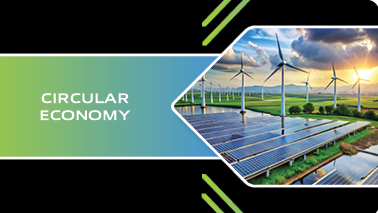
In the energy sector, circularity is essential for managing the massive influx of renewable infrastructure. As the world deploys millions of solar panels, wind turbines, and lithium-ion batteries, a circular approach ensures these assets do not become the next generation of environmental waste. This involves "second-life" applications, such as using retired electric vehicle batteries for stationary grid storage, and advanced recycling techniques that recover rare minerals like cobalt, lithium, and copper with near-100% efficiency. Furthermore, the transition is underpinned by a shift toward Renewable Energy, which provides the clean power necessary to run the circular processes of remanufacturing and recycling.
Beyond material management, the circular economy fosters innovative business models like Product-as-a-Service (PaaS) and Sharing Platforms. Instead of owning a product, consumers pay for its function or "service" such as light, mobility, or cooling while the manufacturer retains ownership and responsibility for the asset’s maintenance and eventual recovery. This aligns the manufacturer’s incentives toward longevity and resource efficiency rather than planned obsolescence. By integrating these circular strategies with digital tools like AI and blockchain for material tracking, the global economy can transform into a resilient, low-carbon system that operates within the finite boundaries of our planet.
Share this page on your timeline
ALSO READ Renewable Clean Energy Systems Solar Photovoltaic Technologies Floating Solar Systems Wind Energy and Wind Technologies Hybrid Renewable Energy Systems Bioenergy and Biomass Waste-to-Energy Technologies Geothermal Energy Systems Marine and Tidal Energy Smart Grids Power Systems Microgrids and Distributed Energy Resources Power Electronics for Renewable Integration Grid Stability and Reliability Cybersecurity in Power Systems AI and Machine Learning in Power Systems Digitalization of Energy Systems IoT Applications in Energy Advanced Battery Technologies Grid-Scale Energy Storage Long-Duration Energy Storage Thermal Energy Storage Systems Hydrogen Production and Storage Fuel Cell Technologies Sustainable Power Energy Efficiency Energy-Efficient Buildings Smart Cities and Energy Systems Energy Management Systems Industrial Energy Optimization Energy Transition, Policy Future Systems Decarbonization Pathways Net-Zero Energy Systems Carbon Capture, Utilization and Storage Circular Economy Energy Policy and Regulation Climate-Resilient Energy Systems Electric Mobility and Charging Infrastructure Vehicle-to-Grid Technologies Future Power System Technologies Hydro Power
Tags
Wind Energy Conferences
Solar Energy Conferences 2026
Smart Energy Meetings 2026
Power Electronics Conferences Europe
Circular Economy Conferences Japan
Renewable Energy Conferences
Smart Grids Conferences Asia
Power Technologies Conferences Europe
Renewable Energy Conferences Europe
Green Hydrogen Conferences Europe
Green Hydrogen Technology Conferences
Biomass Meetings USA